


When winter arrives, warehouse and distribution center operators pay close attention to heating costs. But while insulation, heating equipment, and building envelopes often receive attention, one source of energy loss can be overlooked: the loading dock.
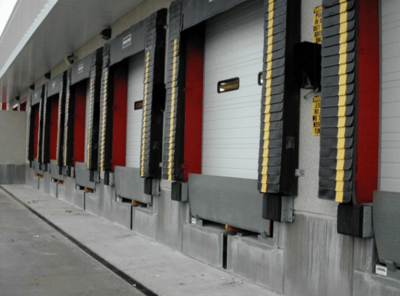 Winter weather can contribute to heat loss and higher energy costs

Every time a trailer backs into a loading dock, the building's conditioned air can escape through gaps around the trailer and dock door. When dock seals or dock shelters are worn, damaged, poorly fitted, or no longer providing adequate compression, those gaps can become an ongoing source of heat loss.
For facilities that operate throughout the winter, repairing or replacing worn dock seals can be a relatively straightforward way to improve energy efficiency. A properly fitted dock seal helps close the space between the loading dock and trailer, reducing drafts and helping keep conditioned air inside the building.
Why Loading Docks Lose So Much Conditioned Air
Loading docks are designed for constant movement. Trucks arrive and depart, dock doors open and close, forklifts move between the warehouse and trailers, and dock equipment operates throughout the day.
That activity makes the loading dock one of the more challenging areas of a building to control from an energy-efficiency standpoint.
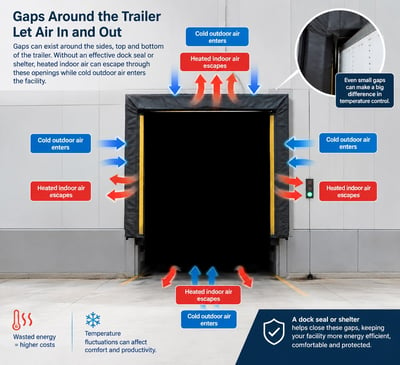
When a trailer is positioned at the dock, gaps can exist around the sides, top, and bottom of the trailer. Without an effective dock seal or shelter, heated indoor air can escape through these openings while cold outdoor air enters the facility.
The problem becomes even more noticeable when existing seals are compressed, torn, deteriorated, or incorrectly sized.
A dock seal that once provided a tight fit may no longer perform the same way after years of exposure to trailers, weather, forklifts, and daily loading activity.
The result is more than an uncomfortable draft. During an entire heating season, repeated air leakage can contribute to increased heating demand and higher operating costs.
Worn Dock Seals Are an Easy Problem to Overlook
Unlike a broken dock leveler or malfunctioning vehicle restraint, a damaged dock seal may not immediately stop loading operations.
That can make it easy for facility managers to postpone replacement.
However, visible wear should not be ignored simply because the dock remains operational. Torn foam pads, compressed seals, gaps around the trailer, damaged fabric, and deteriorated weather seals can all indicate that the dock is no longer providing the protection it was designed to provide.
Facility managers should periodically inspect dock seals and shelters, particularly before the winter season.
Look for:
✦ Torn or damaged side pads
✦ Compressed or deteriorated foam
✦ Gaps between the trailer and seal
✦ Damaged head pads
✦ Worn dock shelter fabric
✦ Missing or deteriorated draft wedges
✦ Gaps around the dock leveler
✦ Damaged or worn door strips
✦ Seals that no longer match the trailer or dock configuration
These conditions can reduce the effectiveness of the dock enclosure and allow conditioned air to escape.
A Properly Sized Dock Seal Makes a Difference
Not every loading dock has the same configuration.
Door dimensions, dock height, trailer sizes, driveway grade, and the physical layout of the loading area can all affect which dock seal or shelter is appropriate.
That is why replacing a worn seal is not simply a matter of installing a generic piece of foam.
A properly specified dock seal should be selected based on the characteristics of the opening and the trailers using the dock. Our dock seal and shelter product line includes a range of configurations designed around different door openings, dock heights, and driveway conditions.
The goal is to create an effective seal between the building and trailer while still allowing trucks to safely and efficiently use the loading dock.
For facilities with multiple docks, evaluating each opening individually can also help identify locations where energy loss or weather infiltration may be particularly significant.
Foam-Filled Head and Side Pads Help Reduce Air Leakage
One of the most important components of a dock seal is the padding that surrounds the trailer.
Foam-filled head and side pads are designed to compress against the trailer as it backs into the dock. This creates a tighter interface around the trailer and reduces the amount of open space through which outside air can enter.
Over time, however, repeated trailer contact can compress or damage the foam. Once the pads have deteriorated, the dock may no longer maintain the same level of contact.
Replacing worn pads can therefore be an important part of restoring the effectiveness of a loading dock seal.
A tighter seal can help reduce drafts around the trailer and improve the overall energy efficiency of the loading area.
Small Gaps Can Add Up
Large gaps around a trailer are easy to recognize, but smaller openings shouldn't be overlooked.
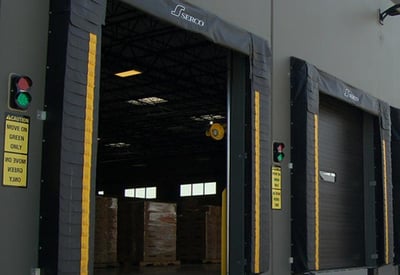
Draft wedges and door strips can help address smaller gaps around the dock opening. While each individual gap may seem insignificant, multiple openings across several loading docks can contribute to noticeable air infiltration over time.
This is particularly important during the winter, when the temperature difference between the heated warehouse and outdoor air can be substantial.
Addressing these smaller openings can complement a larger dock seal or shelter upgrade and provide a more complete approach to controlling air movement around the loading dock.
Don't Forget the Gap Around the Dock Leveler
The dock leveler is another area where air can escape.
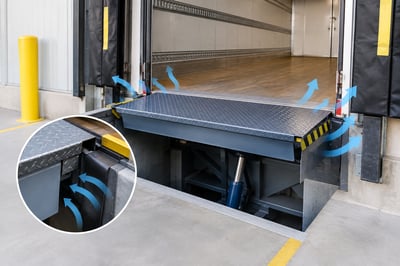
During loading and unloading, the leveler bridges the gap between the warehouse floor and trailer. The area around the leveler and pit can create additional opportunities for conditioned air to escape if it is not properly sealed.
A solution such as a dock leveler pit seal is designed to help close the gap between the dock leveler and pit wall while the leveler is in use.
Addressing this area can be particularly useful when a facility is already upgrading its dock seals and looking for additional ways to reduce air leakage.
Instead of treating the dock seal as an isolated component, facility managers can evaluate the entire dock opening and identify the different locations where outside air can enter.

Why Winter Is a Good Time to Evaluate Dock Seals
A worn dock seal can be a year-round maintenance issue, but its impact becomes especially apparent during cold weather.
Employees may notice drafts around loading docks. Heating equipment may have to work harder to maintain indoor temperatures. Areas near dock doors can become noticeably colder than the rest of the facility.
These conditions are often signs that the loading dock deserves closer attention.
Replacing deteriorated seals before or during the heating season allows facility managers to address a problem that can otherwise continue throughout the winter.
For businesses planning maintenance and capital improvements, dock seal replacement can also be easier to justify than larger energy-efficiency projects. It addresses an identifiable source of air leakage without requiring a major building renovation.
A Small Dock Upgrade Can Support a Larger Energy Strategy
Improving loading dock seals should not be viewed as a substitute for proper building insulation, efficient heating equipment, or other energy-saving measures.
Instead, it can be one part of a broader facility efficiency strategy.
A warehouse may have excellent insulation and modern HVAC equipment, but if conditioned air continually escapes through poorly sealed loading docks, some of that efficiency is being undermined.
This is particularly relevant for facilities with multiple dock positions.
Consider a distribution center with numerous loading bays operating throughout the day. Each opening represents another opportunity for air infiltration when a trailer is not properly enclosed by a dock seal or shelter.
Even relatively small improvements at individual dock positions can become more meaningful when applied across an entire facility.
When Should a Dock Seal Be Replaced?
There is no universal replacement schedule that applies to every dock seal.
Service life depends on factors such as the amount of trailer traffic, frequency of use, weather exposure, trailer alignment, installation conditions, and the quality and design of the original equipment.
Instead of replacing seals based solely on age, facility managers should evaluate their actual condition and performance.
A dock seal that is several years old but remains in good condition may continue to perform effectively. Conversely, a heavily used dock with damaged or compressed pads may need attention much sooner.
If employees can see daylight around a trailer where the seal should be making contact, if foam is visibly compressed or torn, or if the dock area has developed noticeable drafts, it may be time for an inspection.
Worn dock seals have to be replaced to improve the seal between the warehouse and trailer
Don't Wait for the Heating Bill to Tell You
Energy costs are a significant operating expense for many warehouses and distribution facilities. While no single maintenance project can eliminate those costs, addressing obvious sources of conditioned-air loss is a practical place to start.
Worn dock seals are particularly worth examining because the problem is relatively easy to identify and, in many cases, straightforward to correct.
A properly fitted dock seal or shelter can help reduce air infiltration around trailers while also providing better protection from outdoor weather conditions.
For businesses preparing for another winter, the question is simple: are your loading dock seals still doing their job?
We Can Help With Dock Seal and Shelter Solutions
Overhead Door Company of the Meadowlands & NYC provides loading dock equipment solutions for businesses throughout New Jersey and the New York City metro area. Our services include loading dock equipment installation, repair, replacement, and maintenance.
If your dock seals or shelters are torn, compressed, deteriorated, or no longer providing an effective seal around trailers, our team can help evaluate the condition of your loading docks and identify an appropriate solution.
We work with a range of commercial loading dock products, including dock seals, dock shelters, weather seals, dock bumpers, dock levelers, vehicle restraints, and other equipment designed to keep loading operations safe, efficient, and reliable.
Don't let worn dock seals turn into unnecessary winter energy loss. Contact us at 973-471-4060 or info@loadingdock.com to discuss your loading dock requirements and find out whether upgrading your seals or shelters makes sense for your facility.
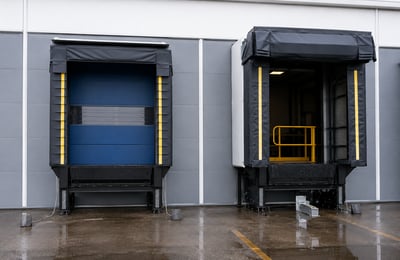 Dock seals and dock shelters in the NYC metro area and NJ